
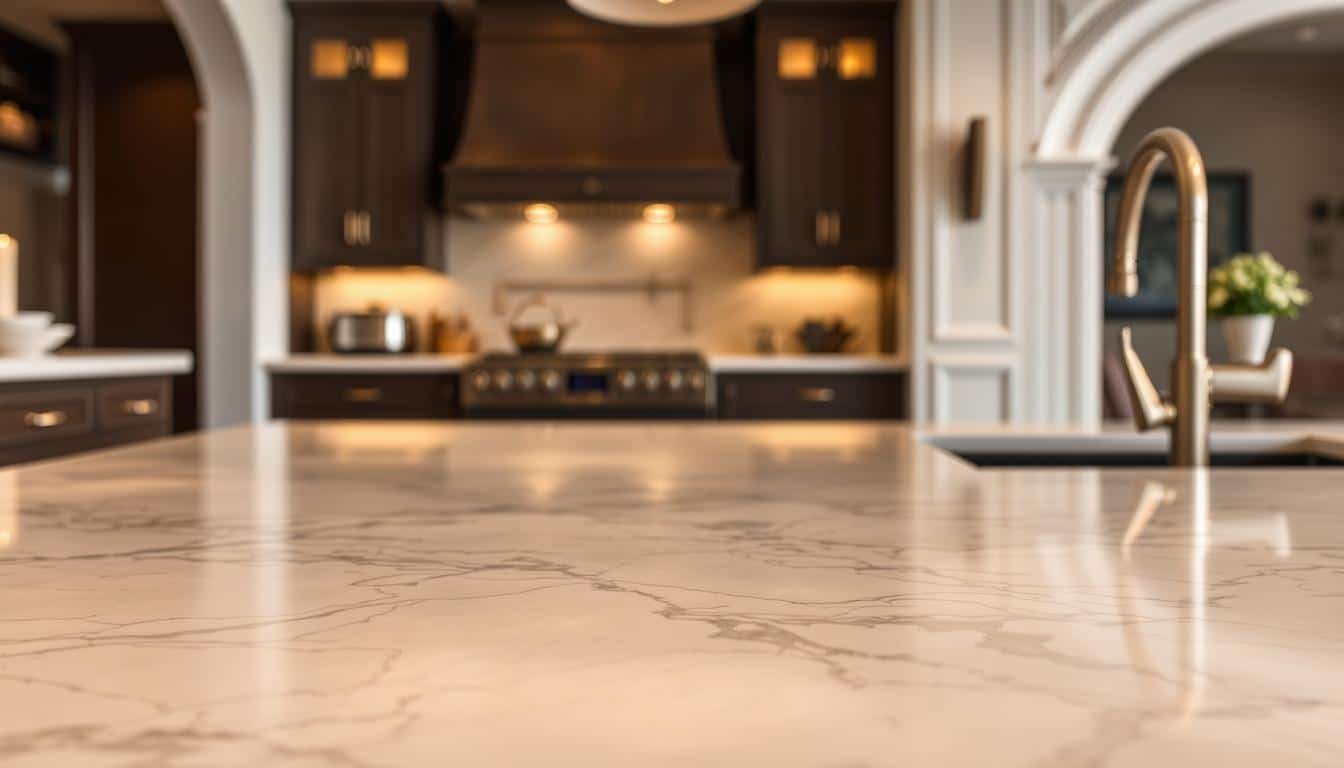
What does Portrush look like?
Cambria describes Portrush as a creamy white design with navy, grey and black veining, fine lines and gold-toned flecks. Its official product page is the reference for the design; a styled kitchen image is not a substitute for the actual sample.
A practical starting point is to decide whether the worktop should be the room’s main pattern. Compare it with a quieter cabinet finish and then with any patterned flooring or tiles you are considering. This makes it easier to judge whether the combination feels balanced to you.
Compare a sample with the slab view
Use the sample for background tone and finish, and the slab view for the larger movement of the veins. Place the sample beside the actual cabinet door rather than relying on separate photographs taken in different light.
If a particular section of pattern attracts you, identify it early. Ask how a comparable arrangement could fit your worktop dimensions, and where joints or cut-outs would interrupt the design.
Plan the island and adjoining pieces
For a prominent island, mark the edge most visible from the room entrance and the side used for seating. This gives the layout conversation a clear starting point.
Include any end panel or matching wall section in that discussion. Pattern alignment is a fabrication detail to agree, not an outcome that can be assumed from the colour name.
Confirm finish, specification and supply
Cambria lists polished and Cambria Matte finishes on its product page. Confirm the exact finish, thickness and current UK supply route before specifying your kitchen; a global product listing does not establish local stock.
This is an informational design guide. Our current online colour catalogue features Classic Quartz Stone. An enquiry about Portrush needs a separate availability check and does not imply that we hold it in stock.
Keep the care instructions with your plan
Cambria recommends warm water and a soft cloth, with mild soap if needed, and advises against sealers. Follow its current product-care instructions for the chosen finish.
When comparing quotations, use the same complete plan and finishing details for every option. That makes the practical differences easier to understand than comparing the slab name alone.