
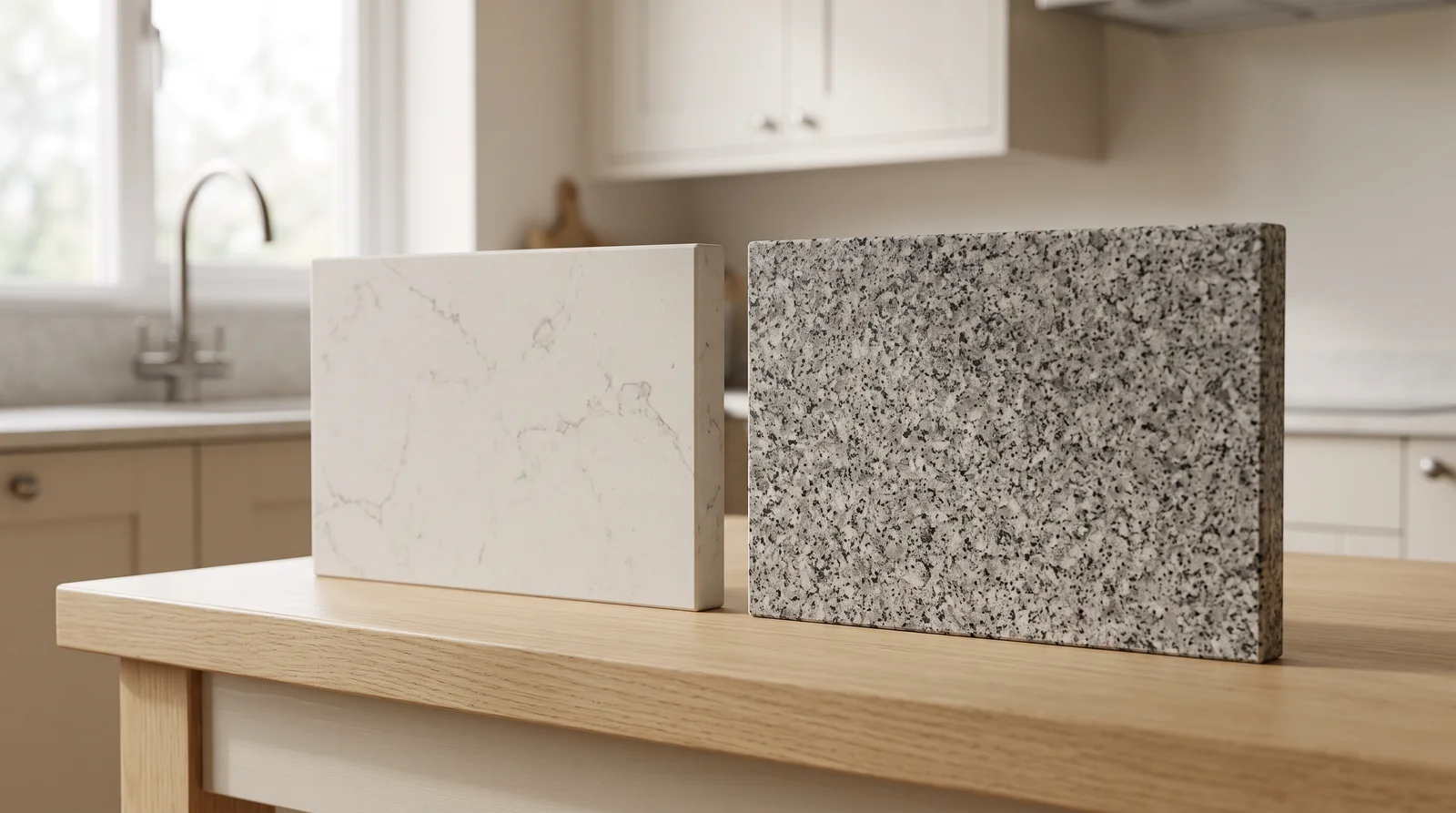
Start with the appearance of the full slab
Quartz is an engineered surface; granite is natural stone. Both offer a wide range of appearances, so a material name alone is not enough to decide which one works with your kitchen.
A small sample helps you judge the background tone. A full slab image helps you understand the larger pattern and how it might run across an island. For granite, ask to see the particular slab being considered because the distribution of colour and minerals varies.
Place shortlisted samples beside a cabinet door and your flooring choice. Compare them in daylight and under the lighting you expect to use in the evening. Treat a photograph as the beginning of the selection process.
Compare the everyday care
Classic Quartz Stone recommends mild cleaning, prompt attention to spills and protection from hot pans and direct cutting. Its care instructions do not support treating quartz as heat-proof or scratch-proof.
Granite care depends on the particular stone and its treatment. The Natural Stone Institute explains that many stones do not need sealing. Where a sealer is appropriate, it improves stain resistance rather than making a surface stain-proof. Ask for care instructions for the slab you choose.
Think about the finished kitchen
A slab must work as a set of finished pieces. Discuss the whole layout, including the sink, hob, island and wall sections, before settling on an image of how the kitchen should look.
- Show every worktop run, change of direction and separate island on your plan.
- Identify cut-outs, tap holes and visible edges.
- Discuss likely joint positions and the direction of any prominent pattern.
- Include upstands, splashbacks and island end panels in the same specification.
A practical comparison
| Decision | Quartz | Granite |
|---|---|---|
| Appearance | Compare the exact design, sample and slab view. | Compare the actual natural slab selected for the job. |
| Care | Follow the brand’s instructions for the specific surface. | Confirm the stone’s care and any sealing needs. |
| Layout | Review how the design falls across individual pieces. | Review how the natural pattern falls across individual pieces. |
| Quotation | Price the complete plan and finishing details. | Price the same complete plan for a fair comparison. |
Compare quotes on the same basis
Check that both quotations cover the same dimensions, thickness, cut-outs, edge finish, wall sections and installation scope. Ask which preparation tasks are included and which need another trade.
Shortlist the surfaces you would actually be happy to live with, then request an itemised quotation. A low headline rate cannot tell you whether two offers describe the same finished kitchen.